Perception Kits · Autonomy & Field Robot Kit
HyperEdge 900DR — Highway Autonomy Essential Perception Kit
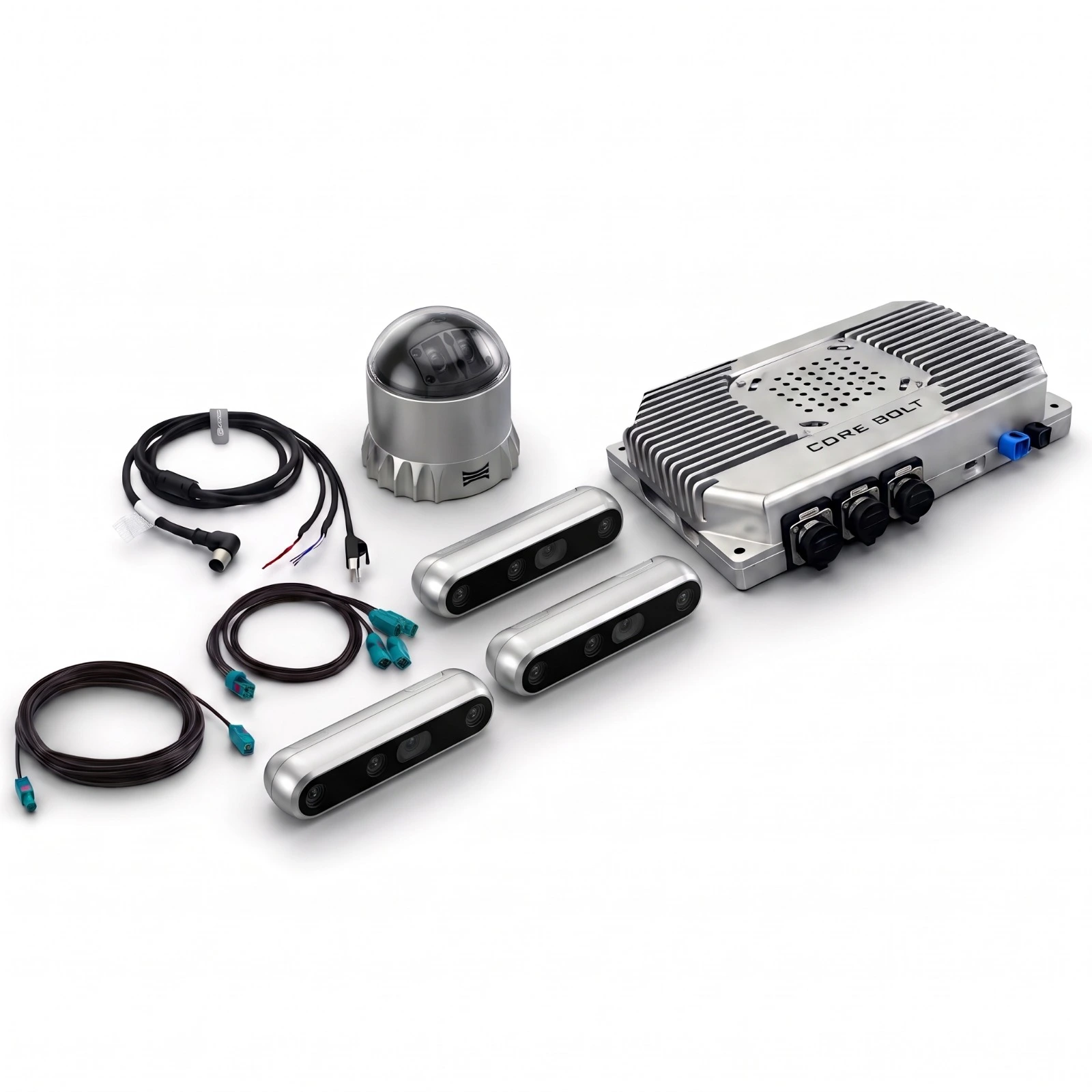
The HyperEdge 900DR Highway Autonomy Essential Perception Kit is a configurable hardware kit for autonomous vehicle development and research. It combines CORE BOLT's HyperEdge 900DRV automotive Edge AI Computer (NVIDIA Jetson AGX Orin + TI TDA4VM) with your choice of 3D LiDAR (Ouster OS1, Ouster OSDome or Livox Mid-360S) and camera (Stereolabs ZED X or Intel RealSense D455), for environmental perception, object detection and multi-sensor data processing.
Specifications
- System Configuration
- HyperEdge 900DRV — AI Edge Computer
- HyperEdge 900DRV — Interfaces & Environment
- Ouster OS1 Rev8 — 3D LiDAR
- Ouster OSDome Rev8 — 3D LiDAR(Optional)
- Livox Mid-360S — 3D LiDAR (Option)
- Stereolabs ZED X — GMSL2 Stereo Camera
- RealSense™ Depth Camera D455(Optional)
- Integration & Connectivity
- Deployment Notes
Specifications
Technical Specifications
HyperEdge 900DR — Highway Autonomy Kit (Essential) — System Configuration
| Parameter | Specification |
|---|---|
| Product Type | Integrated AI Perception Kit |
| Primary Compute | CoreBolt HyperEdge 900DRV |
| Compute Configuration | NVIDIA Jetson AGX Orin 32GB or 64GB + TI TDA4VM |
| Maximum AI Performance | Up to 208 TOPS (AGX Orin 32GB) or 275 TOPS (AGX Orin 64GB), plus TI TDA4VM (8 TOPS) |
| 3D LiDAR | One of: Ouster OS1 Rev8, Ouster OSDome Rev8 or Livox Mid-360S |
| Cameras / Vision | Stereolabs ZED X or Intel RealSense D455 |
| Sensor Interfaces | Ethernet + GMSL2 / FAKRA-Z |
| Perception Functions | Environmental perception, object detection and multi-sensor data processing |
| Deployment Environment | In-vehicle; compute mounted inside the vehicle or in a sealed enclosure, -40 °C to +85 °C |
| Typical Applications | Autonomous driving research and development, highway autonomy prototypes, ADAS data collection, autonomous shuttles and field robots, and university and R&D test vehicles |
HyperEdge 900DRV — AI Edge Computer
| Parameter | Agx Orin 64gb |
|---|---|
| AI Performance | 275 TOPS |
| GPU | 2048-core NVIDIA Ampere GPU, 64 Tensor Cores |
| CPU | 12-core Arm Cortex-A78AE |
| Memory | 64GB 256-bit LPDDR5 204.8 GB/s |
HyperEdge 900DRV — Interfaces & Environment
| Parameter | Specification |
|---|---|
| Processors | TI TDA4VM (8 TOPS) + NVIDIA Jetson AGX Orin, 2 × NVIDIA DLA v2.0 |
| GMSL2 Camera Inputs | 8 channels via 2 × 4-in-1 GMSL2/ GMSL1 connectors |
| Ethernet | 3 × industrial Gigabit Ethernet + 4 × automotive Ethernet (BASE-T1, DRV variant) |
| USB | 1 × USB 3.0 Type-A, 1 × USB 2.0 Type-A |
| Serial / CAN / I/O | Up to 8 × CAN/ CAN-FD, up to 6 × RS232, analog/ digital inputs and outputs, ACC ignition detect |
| Expansion | Mini PCIe (4G), M.2 3052 Key B (5G), M.2 2280 Key M (NVMe SSD), M.2 2230 Key E (Wi-Fi/ BT) |
| Power Input | 9–36 V DC |
| Ingress Protection | IP5X (dust-protected) |
| Operating Temperature | -40°C to +85°C |
| Dimensions | 250.5 × 200.2 × 58.3 mm |
Ouster OS1 Rev8 — 3D LiDAR
| Parameter | Specification |
|---|---|
| LiDAR Type | Mid-range digital LiDAR (Rev8) |
| Channels | 128 |
| FOV (H × V) | 360° × 45° |
| Detection Range | 90 m @ 10% reflectivity (250 m max) |
| Point Rate | Up to 10.4M pts/s |
| Colour | Native colour |
| Operating Temperature | -40°C to +85°C |
| IP Rating | IP68, IP69K |
Ouster OSDome Rev8 — 3D LiDAR(Optional)
| Parameter | Specification |
|---|---|
| LiDAR Type | Hemispherical digital LiDAR (Rev8) |
| FOV | 180° hemispherical |
| Detection Range | 20 m @ 10% reflectivity |
| Colour | Native colour |
| Operating Temperature | -40°C to +85°C |
| IP Rating | IP68, IP69K |
Livox Mid-360S — 3D LiDAR (Option)
| Parameter | Specification |
|---|---|
| LiDAR Type | Hybrid solid-state 3D LiDAR |
| FOV (H × V) | 360° × 59° (-7° to +52°) |
| Detection Range | 40 m @ 10% reflectivity (100 m cut-off) |
| Minimum Range | 0.1 m |
| Point Rate | 200,000 pts/s (first return) |
| Frame Rate | 10 Hz (typical) |
| IMU | Built-in |
| Interface | 100BASE-TX Ethernet |
| Power | 6.5 W typical, 9–27 V DC |
| Dimensions | 65 × 65 × 60 mm |
| Weight | 265 g |
| Operating Temperature | -20°C to +55°C |
| IP Rating | IP67 |
Stereolabs ZED X — GMSL2 Stereo Camera
| Parameter | Specification |
|---|---|
| Image Sensors | Dual 2.3 MP global shutter, 1920 × 1200 |
| Frame Rate | 60 fps @ 1920 × 1200; 120 fps @ 960 × 600 |
| Stereo Baseline | 120 mm |
| FOV | Up to 120° (2.2 mm lens) |
| Depth Range | 0.3 m to 20 m (2.2 mm lens) |
| Interface | GMSL2, FAKRA-Z, up to 15 m |
| Power | ~1.4 W, power over GMSL2 |
| IMU | Yes |
| Operating Temperature | -20°C to +60°C |
| IP Rating | IP67 |
| Weight | 239 g |
RealSense™ Depth Camera D455(Optional)
| Parameter | Specification |
|---|---|
| Use Environment | Indoor / Outdoor |
| Depth Technology | Stereoscopic |
| Image Sensor Technology | Global Shutter |
| Ideal Range | 0.6 m to 6.0 m |
| Minimum Depth Distance (Min-Z) | ~52 cm |
| Depth Accuracy | <2% at 4 m |
| Depth Field of View (FOV) | 87° × 58° |
| Depth Output Resolution | Up to 1280 × 720 |
| Depth Frame Rate | Up to 90 fps |
| RGB Sensor Technology | Global Shutter |
| RGB Sensor Resolution | 1 MP |
| RGB Sensor FOV (H × V) | 90° × 65° |
| RGB Frame Resolution | Up to 1280 × 800 |
| RGB Frame Rate | 30 fps |
| Stereo Baseline | 95 mm |
| Connectors | USB Type-C (USB 3.1 Gen 1) |
| Dimensions (L × D × H) | 124 mm × 26 mm × 29 mm |
Integration & Connectivity
| Component | Interface | Connected To | Function |
|---|---|---|---|
| Ouster OS1 Rev8 | Ethernet | HyperEdge Industrial GbE (via managed switch) | Mid-range primary perception |
| Ouster OSDome Rev8 | Ethernet | HyperEdge Industrial GbE (via managed switch) | Overhead & immediate near-field coverage |
| Livox Mid-360S | Ethernet | HyperEdge Industrial GbE | Compact 360° LiDAR option |
| Depth Camera D455 | GMSL2 / FAKRA-Z | HyperEdge GMSL2 (4-in-1) | Close-range global-shutter stereo depth |
| Stereolabs ZED X | GMSL2 / FAKRA-Z | HyperEdge GMSL2 (4-in-1) | Close-range global-shutter stereo depth |
| HyperEdge 900DRV | TI TDA4VM + NVIDIA Jetson AGX Orin | System Compute | AI Inference & Sensor Processing |
| NVMe SSD | M.2 Key M | HyperEdge 900DRV | Models, Applications & Data Storage |
Deployment Notes
| Parameter | Details |
|---|---|
| Customer-Supplied Items | RTK GNSS + tactical IMU, HD map, redundant teleoperation link, certified E-stop chain, and perception, localisation, planning and vehicle-control software |
| Time Sync | Hardware PTP is not specified for this platform |
| Ingress | IP5X compute — dust-protected, not water-rated; mount inside the vehicle or in a sealed enclosure |
| Safety | Perception hardware does not control the vehicle directly — an independent, certified E-stop chain is mandatory |
Overview
Perception Kit for Highway Autonomy Development
Explore the HyperEdge 900DR highway autonomy perception kit: Jetson AGX Orin + TI TDA4VM compute with configurable 3D LiDAR and cameras for AV development.
Autonomous driving teams need a reliable, in-vehicle platform for collecting and processing LiDAR and camera data. The HyperEdge 900DRV provides the computing: an NVIDIA Jetson AGX Orin module (208 TOPS with 32GB, 275 TOPS with 64GB) alongside a TI TDA4VM processor, with 8 GMSL2 camera channels, automotive Ethernet (BASE-T1), up to 8 CAN/CAN-FD ports and a -40 °C to +85 °C operating range.
Sensors are selected to suit the vehicle: the Ouster OS1 Rev8 (128 channels, 360° × 45°) for mid-range primary perception, the OSDome for hemispherical near-field coverage, or the Livox Mid-360S as a compact option. The camera is either a Stereolabs ZED X or an Intel RealSense D455. This entry-level configuration provides the computing and perception foundation for Physical AI work in autonomous vehicles.
The kit is supplied as hardware. Perception, localisation, planning and vehicle-control software are developed or provided by the customer. Perception hardware does not control the vehicle directly.
What's in the Kit
- 1 × CORE BOLT HyperEdge 900DRV Edge AI Computer (NVIDIA Jetson AGX Orin + TI TDA4VM)
- 1 × 3D LiDAR: Ouster OS1 Rev8, Ouster OSDome Rev8 or Livox Mid-360S
- 1 × camera: Stereolabs ZED X or Intel RealSense D455
Key features
- Dual-processor computing: NVIDIA Jetson AGX Orin (up to 208/275 TOPS) + TI TDA4VM (8 TOPS)
- 8 GMSL2 camera channels via 2 × 4-in-1 connectors
- 3 × industrial Gigabit Ethernet + 4 × automotive Ethernet (BASE-T1)
- Up to 8 × CAN/CAN-FD, up to 6 × RS-232, analog/digital I/O, ignition (ACC) detect
- -40 °C to +85 °C operating range, 9–36 V DC vehicle power input
- Configurable LiDAR and camera selection to match the vehicle architecture
Applications
Autonomous driving research and development, highway autonomy prototypes, ADAS data collection, autonomous shuttles and field robots, and university and R&D test vehicles.
Frequently Asked Questions
What is a highway autonomy perception kit?
It is a pre-matched set of in-vehicle computing and sensing hardware, typically an automotive edge AI computer with 3D LiDAR and cameras, used to develop and test perception for autonomous vehicles on highways.
Which LiDAR and camera options are available?
You can choose an Ouster OS1 Rev8, an Ouster OSDome Rev8 or a Livox Mid-360S LiDAR, and a Stereolabs ZED X or Intel RealSense D455 camera, depending on range, field of view and mounting needs.
Why does the HyperEdge 900DRV use both Jetson AGX Orin and TI TDA4VM?
The NVIDIA Jetson AGX Orin handles GPU-accelerated AI inference and sensor processing. The TI TDA4VM is an automotive processor that adds 8 TOPS of additional processing for vehicle applications.
Is GNSS or an IMU included in the Essential kit?
No. RTK GNSS and a tactical IMU are customer-supplied for this kit. The Highway Autonomy Advanced kit adds an RTK GNSS/INS receiver and radar.
Does the kit include autonomous driving software?
No. The kit provides the computing and perception hardware. Perception, localisation, planning and control software are developed or provided by the customer.
Can the kit be mounted outside the vehicle?
The HyperEdge 900DRV is IP5X and not water-rated, so it should be mounted inside the vehicle or in a sealed enclosure. The LiDARs are mounted externally according to their own IP ratings.