Robotics has evolved significantly over the past few decades. Traditional robots have transformed manufacturing, industrial automation, and production processes through programmable movements and repetitive operations. However, the integration of artificial intelligence (AI), advanced sensors, machine vision, and edge computing is changing how modern robotic systems operate.
The emergence of Physical AI is taking robotics beyond conventional automation. By combining AI-powered computing with physical machines and sensors, modern robotic systems can perceive their surroundings, process real-world information, and respond to changing conditions.
The difference between traditional robotics and next-generation robotics goes beyond automation. While traditional robots primarily follow predefined instructions, next-generation robotics combines AI-powered decision-making, environmental perception, real-time data processing, and autonomous navigation to perform more complex tasks.
From industrial manufacturing and warehouse automation to autonomous mobile robots (AMRs), Physical AI is enabling machines to interact with the physical world with greater intelligence and adaptability.
1. How Does Traditional Robotics Work?
Traditional robotics refers to robotic systems designed to perform predefined tasks using programmed instructions, fixed sequences, and established control mechanisms.
These robots typically operate in controlled environments where tasks are repetitive, predictable, and structured. Their movements and actions are determined by preprogrammed logic, conventional controllers, and mechanical components.
Traditional industrial robots are widely used for:
- Assembly line operations
- Welding and material handling
- Pick-and-place applications
- Painting and coating
- Packaging and palletizing
- Repetitive manufacturing processes
For example, a traditional robotic arm on an assembly line can repeatedly pick up components and place them in predetermined positions. The robot follows its programmed sequence with high accuracy and repeatability.
However, traditional robots generally have limited environmental awareness. If a component moves outside its expected position or an unexpected obstacle appears, the robot may require additional sensing capabilities, reprogramming, or human intervention.
Practical Example: Traditional Robotic Arm vs. AI-Enabled Robotic System
Consider a robotic arm used to pick and place components on a manufacturing line.
Traditional Robotic Arm:
- Follows predefined movement coordinates and programmed instructions
- Picks up components from fixed positions
- Places components at predetermined locations
- Relies on established operating conditions and programmed sequences
- May require reprogramming or additional integration when component positions change
AI-Enabled Robotic System:
- Uses cameras to capture visual information about components
- Applies AI-based object detection to identify component positions and orientations
- Uses depth information or LiDAR data, where appropriate, to understand distances and surrounding objects
- Processes sensor information through an Edge AI Computer
- Provides updated perception information to motion-planning and control systems
For example, if components arrive in different orientations, an AI-enabled robotic system can use machine vision to identify their positions and orientations. The perception software can then provide updated object information to the motion-planning system, which calculates an appropriate movement path.
The main difference is that traditional robotics primarily executes predefined instructions, whereas AI-enabled robotic systems use perception data and AI inference to identify environmental changes and provide updated information to motion-planning and control systems.
Next-generation robotics builds upon traditional capabilities by introducing AI, advanced perception systems, and intelligent computing. These technologies support more adaptive operations and form an important foundation for Physical AI.
2. Traditional vs. Next-Generation Robotics: Key Differences
The most important difference between traditional and next-generation robotics is how robotic systems interact with their environments and respond to information.
| Feature | Traditional Robotics | Next-Generation Robotics |
|---|---|---|
| Operating principle | Predefined instructions | AI-assisted intelligence |
| Decision-making | Programmed logic | AI-based processing and control |
| Environmental awareness | Limited or application-dependent | Advanced perception capabilities |
| Sensors | Basic or task-specific sensors | LiDAR, cameras, and multiple sensors |
| Computing | Conventional controllers | AI-enabled computing platforms |
| Navigation | Fixed or programmed paths | Autonomous and adaptive navigation |
| Flexibility | Best for repetitive tasks | Better suited to dynamic environments |
| Adaptability | Requires reprogramming for changes | Can respond to changing conditions |
| Data processing | Conventional control processing | Real-time sensor and AI processing |
Traditional robotics remains valuable for repetitive and highly controlled operations. Next-generation robotics extends these capabilities through intelligent perception, adaptive processing, and autonomous functionality.
Physical AI builds on these advancements by connecting AI capabilities with physical machines that can sense, interpret, and respond to real-world conditions.
3. How Are AI and Physical AI Changing Industrial Robotics?
Artificial intelligence is transforming industrial robotics by enabling machines to process information, recognize patterns, and support more complex operations.
Physical AI extends these capabilities by integrating AI models with physical systems and sensors. This allows robots to use information from their surroundings to support intelligent actions in the real world.
Some important applications include:
Intelligent Object Recognition
AI-powered vision systems help robots identify objects based on their shape, position, orientation, and visual characteristics. This is useful in sorting, inspection, and automated picking applications.
Adaptive Manufacturing
AI can help robotic systems respond to variations in manufacturing processes, identify irregularities, and support flexible production operations.
Predictive Maintenance
Machine learning algorithms can analyze operational data to identify unusual patterns and potential equipment problems before failures occur.
Autonomous Material Handling
AI-enabled mobile robots can use environmental information to navigate facilities, identify obstacles, and support material transportation.
Quality Inspection
Machine vision systems can analyze products for defects, inconsistencies, and dimensional variations during manufacturing.
These capabilities make AI and Physical AI important components of modern industrial automation.
4. Why Are Perception Systems Important in Next-Generation Robotics?
A robot needs more than mechanical movement to operate autonomously. It must also understand its surroundings.
Robotic perception systems combine cameras, LiDAR sensors, and other sensing technologies to collect environmental information. The collected data is processed to help robotic systems identify objects, estimate distances, understand spatial relationships, and navigate their surroundings.
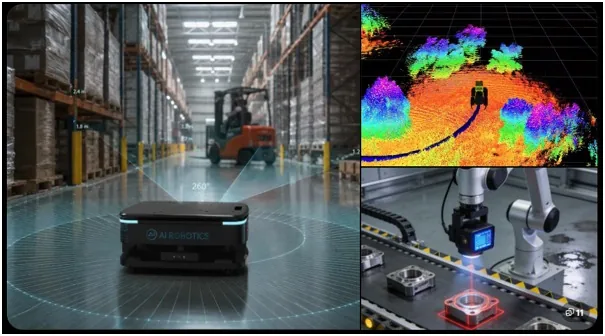
Key Components of Robotic Perception
LiDAR Sensors:
LiDAR measures distances using laser pulses and generates spatial information about the surrounding environment. It produces point cloud data that can be used for 3D mapping, obstacle detection, localization, and autonomous navigation.
Machine Vision Cameras:
Machine vision cameras capture visual information that AI algorithms can analyze for object recognition, classification, tracking, and inspection.
Different camera technologies serve different purposes:
- RGB cameras capture color, texture, and visual details about objects
- Stereo cameras use images from two viewpoints to estimate depth through differences in object positions between images
- Depth cameras use dedicated depth-sensing technologies to provide distance information
- AI-based depth estimation uses trained models to estimate depth from suitable image inputs, although its accuracy depends on the model, input data, and operating conditions
Therefore, depth estimation is not an inherent capability of every conventional RGB camera. It requires suitable stereo imaging, dedicated depth-sensing hardware, or an AI-based depth-estimation technique.
Sensor Fusion:
Sensor fusion combines information from multiple sensing devices to create a more comprehensive understanding of the surrounding environment.
For example, a LiDAR sensor can provide spatial and distance information, while cameras capture visual details such as object appearance, color, and texture.
Combining these data sources can help a robotic system:
- Detect and classify surrounding objects
- Estimate object positions and distances
- Identify obstacles and free space
- Improve environmental mapping and localization
- Support navigation and obstacle avoidance
The effectiveness of sensor fusion depends on accurate sensor calibration, timestamp synchronization, coordinate transformations, and suitable data-processing algorithms.
Real-Time Data Processing:
Sensor information must be processed quickly enough to support navigation, obstacle detection, and other time-sensitive robotic operations.
How Do LiDAR, Cameras, Sensor Fusion, and Edge AI Work Together?
A typical AI-powered robotic perception architecture follows a sequence of interconnected stages:
- Data Acquisition: LiDAR sensors generate point clouds, while cameras capture image or video data from the surrounding environment.
- Sensor Synchronization: Timestamp synchronization and calibration help align information from different sensors so that the data represents the same environment at approximately the same point in time.
- Data Processing: The computing platform receives sensor data through supported interfaces and prepares it for processing.
- Sensor Fusion: Perception software combines relevant information from LiDAR, cameras, and other sensors to improve environmental understanding.
- AI Inference: AI models process the available information to perform tasks such as object detection, classification, tracking, and scene understanding.
- Motion Planning: Planning software uses perception information and other constraints to calculate suitable paths and movements.
- Control Execution: Robot controllers execute the resulting motion commands and use feedback from the robot to manage movement.
Robotic Perception and Computing Architecture
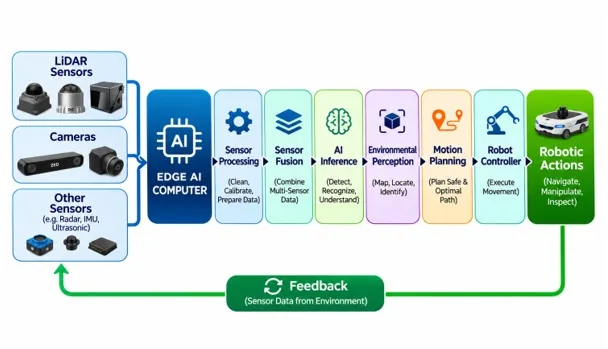
This architecture illustrates the relationship between sensing, computing, perception, planning, and control. Actual implementations may use separate computing units for perception and motion control, depending on the robot's hardware and software architecture.
Together, these technologies provide the environmental awareness required for Physical AI applications, helping robots move beyond predefined movements and interact more intelligently with their surroundings.
5. Applications of Next-Generation Robotics
Next-generation robotics is expanding across industries where machines must operate with greater environmental awareness, flexibility, and autonomy.
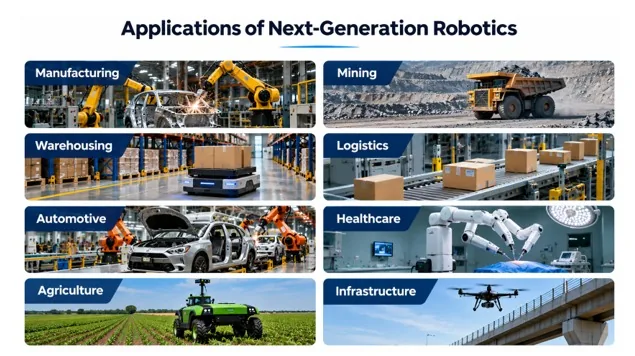
- Manufacturing: AI-based inspection, robotic assembly, defect detection, and flexible automation can support production processes that involve changing components and operating conditions.
- Warehousing: Autonomous mobile robots can use LiDAR, cameras, and onboard computing to support navigation, obstacle detection, automated picking, and material handling.
- Automotive: Autonomous driving, robotic inspection, advanced driver-assistance systems, and intelligent manufacturing use perception and AI computing technologies.
- Agriculture: AI-enabled machinery and autonomous field robots can support crop monitoring, navigation, and precision agricultural operations.
- Mining: Autonomous vehicles and remote inspection systems can use environmental sensing and edge computing to support operations in challenging environments.
- Logistics: Intelligent sorting, warehouse transportation, and automated material movement can benefit from AI-based perception and autonomous navigation.
- Healthcare: Robotic assistance, medical imaging, and medical automation use advanced computing, sensing, and machine vision technologies.
- Infrastructure: Intelligent inspection, traffic monitoring, asset monitoring, and maintenance robotics can use cameras, LiDAR, and AI-based analysis.
These applications demonstrate how Physical AI, robotic perception, and edge computing are expanding the capabilities of robotic systems across different industries.
6. How Does CORE BOLT Support Next-Generation Robotics?
CORE BOLT supports next-generation robotics and Physical AI development through its portfolio of Edge AI Computers, Industrial Computing Platforms, LiDARs, cameras, vision systems, and Perception Kits.
Edge AI Computing Platforms
CORE BOLT's HyperEdge Edge AI Computers, powered by NVIDIA Jetson technologies, including NVIDIA Jetson System-on-Modules (SOMs), provide computing capabilities for embedded AI inference, robotics computing, and intelligent machine applications.
Different platforms address different deployment requirements. For example:
- HyperEdge M300F: A rugged industrial AI edge computer for industrial automation, robotics, and machine vision applications.
- HyperEdge M500: A high-performance AI edge computer designed for demanding workloads, including autonomous mobile robots, industrial automation, and machine vision.
- HyperEdge U300: A compact AI edge computer for robotics, UAVs, video analytics, and distributed intelligent applications.
Industrial Computing Platforms
The HyperCore Industrial Computing Platforms provide industrial computing capabilities for automation, machine control, Industrial IoT, and smart manufacturing.
These platforms support industrial applications that require reliable computing, connectivity, and integration with industrial equipment and systems.
LiDAR Sensors and Vision Systems
CORE BOLT provides LiDAR sensors and camera-based vision solutions for robotics, autonomous systems, industrial automation, and machine perception applications.
Its 3D LiDAR sensor portfolio includes sensing technologies from manufacturers such as Hesai, RoboSense, Livox, Ouster, and others. These solutions support applications involving 3D mapping, obstacle detection, localization, and environmental perception.
Its Vision Systems and Cameras include GMSL cameras, MIPI CSI-2 cameras, GigE cameras, and depth-sensing solutions for machine vision, object recognition, inspection, and autonomous navigation.
Perception Kits for Intelligent Machines
CORE BOLT's Perception Kits combine Edge AI computing, LiDAR integration, multi-camera connectivity, and industrial interfaces into application-oriented hardware platforms.
Depending on the configuration, these kits can support:
- Dual LiDAR integration
- Up to eight GMSL camera connections
- Industrial I/O and communication interfaces
- High-speed sensor connectivity
- AI-ready edge deployment
Supporting Real-World Robotics Applications
These computing and perception solutions can support different robotics development requirements, including:
- Warehouse Robotics: LiDAR-based environmental sensing, camera-based object recognition, and Edge AI computing for AMR navigation and obstacle detection.
- Industrial Machine Vision: Camera-based inspection and AI inference for defect detection, product classification, and quality control.
- Autonomous Vehicles: LiDAR and camera integration with edge computing for environmental perception, object detection, and intelligent mobility applications.
- Agricultural Robotics: Embedded AI computing and sensing technologies for field monitoring, machine vision, and autonomous equipment development.
- Smart Infrastructure: Camera-based analytics, LiDAR sensing, and edge processing for traffic monitoring, infrastructure inspection, and intelligent monitoring systems.
By providing computing platforms, sensing technologies, and integrated Perception Kits, CORE BOLT supports robotics developers, OEMs, and system integrators in developing intelligent machines, autonomous systems, and industrial automation solutions.
Explore CORE BOLT's Edge AI Computers, Industrial Computing Platforms, LiDAR Sensors, Vision Systems and Cameras, and Perception Kits to learn more.
Frequently Asked Questions (FAQs)
1. What is the difference between traditional and next-generation robotics?
Traditional robotics primarily relies on predefined instructions and programmed movements, whereas next-generation robotics integrates AI, advanced sensors, perception systems, and edge computing to support more adaptive and autonomous operations.
2. How is AI used in modern robotics?
AI is used for object recognition, machine vision, environmental perception, predictive maintenance, autonomous navigation, and intelligent decision-making.
3. What technologies are used in next-generation robotics?
Common technologies include artificial intelligence, machine learning, LiDAR sensors, machine vision cameras, sensor fusion, Edge AI computing, and autonomous navigation systems.
4. Why is edge computing important in robotics?
Edge computing enables robotic systems to process sensor data and run AI models locally. This supports real-time processing, reduces dependence on continuous cloud connectivity, and can improve responsiveness in autonomous applications.
5. What is the role of LiDAR in robotics?
LiDAR provides distance measurements and spatial information that help robots understand their surroundings. It is commonly used for 3D mapping, obstacle detection, localization, and autonomous navigation.
6. How do perception systems improve robotic automation?
Perception systems help robots identify objects, detect obstacles, understand spatial information, and respond to environmental changes using data from cameras, LiDAR, and other sensors.
7. Are traditional industrial robots becoming obsolete?
No. Traditional robots remain highly effective for repetitive, predictable, and structured operations. Next-generation robotics expands automation capabilities for more complex and dynamic applications.
8. What is an Edge AI Computer in robotics?
An Edge AI Computer is an embedded computing platform designed to process sensor information and execute AI workloads locally. It can support machine vision, object detection, sensor processing, and autonomous robotic applications.
9. What is the difference between industrial robotics and autonomous robotics?
Industrial robotics generally focuses on automating manufacturing and industrial processes, while autonomous robotics emphasizes the ability of machines to perceive their surroundings, make decisions, and perform tasks with limited human intervention. The two categories can overlap.
10. Which sensors are commonly used in autonomous robots?
Common sensors include LiDAR, RGB cameras, depth cameras, radar, ultrasonic sensors, IMUs, and encoders. The selection depends on the robot's operating environment and application requirements.
11. What is the difference between Physical AI and traditional AI in robotics?
Traditional AI generally refers to artificial intelligence systems that process information, recognize patterns, generate predictions, or make decisions in digital environments. Physical AI applies AI capabilities to physical machines and robotic systems that interact with the real world.
In robotics, Physical AI combines AI models, sensors, perception systems, computing platforms, and control technologies to help machines understand their surroundings and support physical actions. This enables applications such as autonomous navigation, intelligent material handling, robotic inspection, and adaptive manufacturing.